

A stuffy attic turns a storage space into a sauna by midsummer, and warm air creeping down into living rooms quietly drives up cooling costs. The right attic ceiling fans, whether a gable-mounted exhaust or a low-profile fandelier for finished bonus rooms, pull hot air out before it settles. This roundup covers options for whole-house ventilation, workshop airflow, and living-space comfort so you can match the right fan to your real situation.
The Shortlist At A Glance

Air Vent Gable Ventilator 53315 Attic and Whole House Fan

addlon 24″ Low Profile Fandelier Ceiling Fan (Black)

addlon 24″ Low Profile Fandelier Ceiling Fan (White)

VEVOR 24 Inch Shutter Exhaust Fan (7030 CFM)

VEVOR 16 Inch Shutter Exhaust Fan (2438 CFM)

VEVOR 10″ Shutter Exhaust Fan (820 CFM)
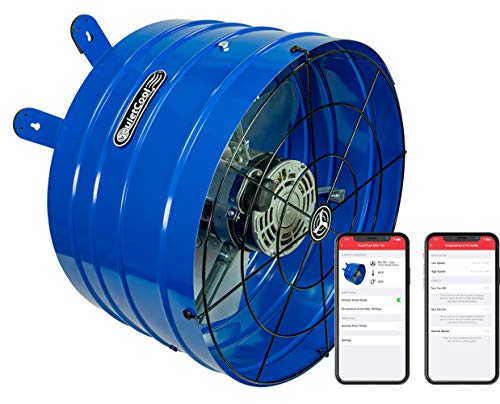
Quietcool AFG SMT PRO-2.0 Smart Attic Fan

Quietcool AFG SMT PRO-3.0 Smart Attic Fan
The Details Behind The Selections
The Air Vent 53315 mounts in a gable end and pulls heat out of the attic like a chimney in reverse, which is why it has stayed a familiar name on the category for years. It is designed for whole-house exhaust on homes up to roughly 1,500 square feet, where a single fan can substitute for window units in milder weather.
Expect a 14-inch blade paired with a 1/12 HP motor that moves about 1,050 CFM, enough to clear a buildup of warm air after a long summer day. The fan runs on standard household current, and homeowners commonly report that pairing it with a thermostat or timer keeps cycling automatic.
Strong Points
- Whole-house airflow up to 1,500 sq ft on a single unit
- Steel-blade construction handles continuous summer cycling
- Standard 120V hookup suits most existing gable wiring
- Effective as a supplement to central AC during shoulder seasons
Things To Consider
- Requires a compatible gable vent frame to mount cleanly
- Louder than smaller DC-powered alternatives on full speed
- No integrated humidistat, so an add-on controller is helpful in damp climates
Who It Suits Best
Homeowners with a standard gable vent and a moderately sized attic who want one workhorse fan rather than a smart, app-driven setup.
Consider Something Else When
The Quietcool AFG SMT PRO-3.0 Smart Attic Fan is the better match for tech-focused users who want app-based scheduling and dual thermostat and humidistat control.
The addlon 24-inch fandelier is a finished-space fan, not a venting solution, so it lands in the attic ceiling fan conversation when the room above the garage has been converted to a bonus bedroom or office. Its hugger-style low profile keeps the body close to the ceiling, which is a relief in rooms under eight feet.
Unlike the Air Vent gable-mounted option above, this one combines a dimmable LED panel with a reversible DC motor, meaning the fan can push air down in summer and pull it up in winter to balance room temperature. Six speeds and app or remote control let you tune the airflow to a quiet overnight setting.
Well-Handled Touches
- Reversible DC motor saves energy compared to older AC fans
- Color-adjustable LED from 3000K warm to 6000K daylight covers work, rest, and entertaining
- Memory function restores your last speed and brightness after a power cycle
- Low profile eliminates the need for a downrod in tight ceilings
Points To Keep In Mind
- App setup can take a few tries for households with mixed smart-home ecosystems
- Black finish shows dust more readily than lighter alternatives
- Integrated LED is not user-replaceable, so the panel is a long-term commitment
Made For
Anyone finishing a bonus room with a low ceiling who wants lighting, airflow, and remote control in one fixture.
Look Elsewhere When
The addlon 24″ Low Profile Fandelier Ceiling Fan in White is the better pick for bright, sunlit rooms where a black fixture would feel heavy or out of place.
Functionally identical to its black sibling above, the white addlon fandelier simply dresses down for rooms with light walls, pale wood trim, or coastal styling. The shared DC motor and LED platform make this a color-driven decision rather than a performance one.
Six speeds, a reversible motor, and the same remote plus app pairing carry over, so the comfort side of the experience is essentially identical. White housings tend to recede into the ceiling, which can help low-ceiling rooms feel taller than they are.
Key Advantages
- White housing visually opens up low-ceiling bonus rooms
- Same dimmable 3000K-6000K LED panel as the black version
- Reversible DC motor supports year-round use
- Timer function is handy for bedrooms and nurseries
Honest Caveats
- Performance is unchanged from the black version, so color is the only real differentiator
- Smart-home pairing steps mirror the black model, including occasional setup retries
Feature Snapshot
Right Fit For
Owners of bright, airy bonus rooms who want the comfort of a fandelier without a dark fixture competing with natural light.
A Better Fit Elsewhere
The VEVOR 24 Inch Shutter Exhaust Fan is a stronger choice for unfinished attics where the goal is to vent hot air rather than cool a finished room.
Where the Air Vent gable fan in slot one is built for residential attics, this VEVOR 24-inch shutter exhaust is more of a brute. The steel housing and automatic louvers target workshops, barns, and larger garages where smoke, fumes, and summer heat stack up fast.
It pushes 7,030 CFM, the highest output in this roundup, and runs on a 1400 RPM AC motor at 185W. In practical terms, a two-car garage with summer afternoon sun gets noticeably cooler within minutes of switching it on.
Positive Takeaways
- 7,030 CFM clears heat and fumes from large spaces quickly
- Automatic louvers open and close with the fan, blocking backdrafts when off
- Steel housing tolerates workshop conditions better than plastic
- Wall-mount design frees up ceiling space for lighting or storage
Trade Offs
- Larger cutout requires accurate framing and a solid mounting surface
- Not a finished-room solution, since the look is industrial
- Louvers can rattle if the frame is not perfectly square during installation
Who Will Love This
Workshop owners, mechanics, and serious DIYers who need real exhaust volume rather than gentle circulation.
Skip It When
The VEVOR 10″ Shutter Exhaust Fan is a smarter call for small greenhouses or sheds where 820 CFM is plenty and a 24-inch cutout would be overkill.
The 16-inch VEVOR sits between the heavy-duty 24-inch model above and the compact 10-inch unit coming up next, which makes it a useful middle ground for medium-sized outbuildings. It is the kind of fan that fits cleanly into a 10×12 shed wall or a small barn without dominating the structure.
At 2,438 CFM with a 1500 RPM motor drawing 77W, it is also notably easier on a standard 15-amp circuit than its larger sibling, which simplifies wiring in older buildings. You still get the same steel housing and auto-louver setup that defines this VEVOR family.
Strengths Worth Knowing
- 2,438 CFM suits medium sheds and small barns
- Lower wattage eases the load on older circuits
- Auto-louvers prevent cold backdrafts in winter
- Same steel construction as the larger VEVOR model
Soft Spots
- Not enough airflow for very large workshops where 7000+ CFM is the goal
- Industrial look is intentional, so it does not blend into finished spaces
Quick Facts
Perfect Match For
Owners of mid-size outbuildings who want real exhaust without stepping up to industrial-scale airflow.
Another Choice May Suit
Workshop owners with high heat loads should consider the VEVOR 24 Inch Shutter Exhaust Fan for its 7,030 CFM ceiling-clearing capacity.
The smallest VEVOR in this roundup, the 10-inch shutter fan, is a good fit for tightly enclosed spaces where a 24-inch cutout would be impractical. Greenhouses, small chicken coops, and garden sheds are its natural territory, and the aluminum housing keeps weight low on thin walls.
At 820 CFM and 1650 RPM, the airflow is modest but targeted, which can actually be a plus in a small greenhouse where you want steady air circulation rather than a gust. The 45W draw means it sips power compared to the larger VEVORs above.
Useful Strengths
- Compact 10-inch frame fits small wall openings
- Aluminum housing is lighter and rust-resistant
- Low 45W draw suits solar and off-grid setups
- Auto-louvers keep out drafts when the fan is idle
A Few Limitations
- 820 CFM is not enough for whole-attic ventilation
- Louvers can occasionally stick if debris collects in the track
- Aluminum housing dents more easily than the steel models above
Feature Card
Best Suited To
Greenhouse growers, hobby farmers, and shed owners who need targeted airflow without rewiring for a heavy-duty circuit.
Reach For A Different Pick When
The Quietcool AFG SMT PRO-2.0 Smart Attic Fan is the better match for residential attic venting where smartphone scheduling adds meaningful value.
Quietcool’s PRO-2.0 is the smaller of two smart gable fans in this roundup, and it leans into a plug-and-play installation story. A 20-foot power cord means most homes can run it to an existing outlet without an electrician, which removes a real barrier for first-timers.
It moves up to 1,945 CFM at 120W on its high setting and steps down to a quieter speed for nighttime use. The companion app supports thermostat and humidistat triggers, so the fan can decide on its own when the attic needs attention.
A Favorable Mix
- Plug-and-play design with a 20-foot cord avoids hardwiring
- Smart app adds scheduling and temperature-based triggers
- Two-speed PSC motor balances output and noise
- Fire-safety shutoff adds peace of mind
Possible Compromises
- 1,945 CFM is fine for average attics but undersized for very large footprints
- App features depend on a stable home Wi-Fi signal in the attic area
- Requires a compatible gable vent for proper fit
At A Glance
Who Should Grab It
Tech-comfortable homeowners who want a smart, app-driven attic fan without committing to a hardwired install.
Where A Sibling Pick Shines
The Quietcool AFG SMT PRO-3.0 Smart Attic Fan is worth the step up for larger attics where 2,940 CFM is needed to clear heat efficiently.
The PRO-3.0 is Quietcool’s larger smart gable fan, and it is built to clear the kind of attic that stays hot long after sunset. At 2,940 CFM on high, it competes with whole-house fans in raw output while still being a plug-and-play install.
You get the same app-based control as the PRO-2.0 above, plus a higher draw at 264W on high. Anti-vibration pads and included vent covers help it run quietly while preventing backdrafts when the attic has finally cooled down.
The Helpful Details
- 2,940 CFM suits larger attics that the PRO-2.0 can struggle with
- Smart app ties in thermostat and humidistat triggers
- Anti-vibration pads reduce noise transfer into living space
- Included vent covers block backdrafts in cooler months
Less-Strong Areas
- Higher power draw means you may notice it on your energy monitor
- Larger footprint needs a generously sized gable vent opening
- Premium position in the line may be more than small attics need
Built With In Mind
Homeowners with larger attics in hot climates who want app-controlled exhaust without giving up ceiling space or finish quality.
Swap It Out When
The Air Vent Gable Ventilator 53315 Attic and Whole House Fan is a simpler, lower-tech alternative for shoppers who prefer a basic hardwired unit over smart features.
What To Weigh Before Choosing Attic Ceiling Fans
Match The Fan To The Space Type
The biggest split in this category is between exhaust fans for unfinished attics and circulation fans for finished rooms. Gable-mounted and shutter exhaust fans like the VEVOR 24 Inch and Quietcool PRO-3.0 exist to push hot air out, while fandeliers like the addlon 24-inch exist to keep people cool in a converted bonus room. Picking the wrong type is the most common reason homeowners end up with a unit that does not move the needle on comfort.
Airflow (CFM) And Home Size
CFM, or cubic feet per minute, measures how much air a fan moves, and matching it to attic square footage matters. A 1,500-square-foot home typically needs a fan in the 1,500 to 2,500 CFM range, while larger homes benefit from 2,900 CFM or more. Sheds, greenhouses, and workshops follow a different rule, where the goal is air changes per hour rather than whole-house coverage.
Noise, Controls, And Power
DC motors tend to run quieter and more efficiently than AC motors, which is why the addlon fandelier and Quietcool smart fans feel gentle in bedrooms. AC motors in the VEVOR shutter lineup deliver higher output at a lower price, but they are louder on full speed. Decide whether you need a thermostat, humidistat, app control, or a simple on/off switch before choosing, since each step up adds complexity.
Installation And Electrical Requirements
A plug-and-play unit with a long power cord, like the Quietcool PRO-2.0, can be installed without an electrician on most homes. Wall-mounted shutter fans typically need a framed opening and a dedicated circuit, which is worth budgeting for. Always confirm the cutout dimensions against your existing vent or wall framing before ordering.
Common Shopping Slip Ups And Where The Money Goes
Where Shoppers Go Wrong
Many people buy a fan rated for the wrong square footage, either over-spec’ing a small attic and paying for airflow it cannot use or under-spec’ing a large one and wondering why the heat never clears. Another common trap is ignoring backdraft protection, which lets cold air pour in during winter and quietly undoes any heating efficiency. Finally, choosing an industrial shutter fan for a finished bonus room, or a low-profile fandelier for an unfinished attic, leads to a fan that simply does not fit the job.
What The Higher Tier Buys
Stepping up to a premium smart attic fan like the Quietcool PRO-3.0 typically delivers more CFM, dual thermostat and humidistat logic, anti-vibration hardware, and included vent covers. The upgraded motor and electronics also tend to be more efficient per cubic foot of air moved, which can offset some of the higher upfront cost over a long cooling season. For most homes, the upgrade pays off when the attic is large, the climate is hot, and the homeowner actually uses the scheduling features.
Frequently Asked Questions
What size attic fan do I need for a typical home?
Most homes between 1,000 and 2,000 square feet do well with a fan in the 1,500 to 2,500 CFM range. Larger homes or homes in very hot climates benefit from 2,900 CFM or more, like the Quietcool AFG SMT PRO-3.0 Smart Attic Fan.
Can I install an attic fan without an electrician?
Plug-and-play models such as the Quietcool AFG SMT PRO-2.0 Smart Attic Fan come with a long power cord and a standard plug. They can typically be installed in an afternoon without running new wiring.
Are fandeliers a good substitute for an attic exhaust fan?
No, fandeliers like the addlon 24″ Low Profile Fandelier Ceiling Fan circulate air in a finished room rather than venting hot air out of the attic. They are a good match for converted bonus rooms, not for whole-house attic cooling.
Do smart attic fans actually save energy?
Smart attic fans can save energy by running only when temperature or humidity thresholds are met, rather than continuously. The savings depend on your climate, attic size, and how often you remember to adjust a manual thermostat.
How loud are shutter exhaust fans?
Wall-mounted shutter fans with AC motors, like the VEVOR 24 Inch Shutter Exhaust Fan, are noticeably louder than DC smart fans, especially on high speed. They are typically installed in workshops or garages where noise is less of a concern.
