

A high-ceilinged workshop, a barndominium with soaring rafters, a converted loft where a regular fan just whimpers against the dead air up top: that’s where oversized ceiling fans earn their keep. You don’t need a hurricane in your living room, you need movement, the kind that takes the edge off a stuffy August afternoon without a noisy box fan rattling in the corner. This list looks at seven big industrial ceiling fans that move serious air, stay quiet enough to live with, and look intentional rather than industrial-pure.
The Main Contenders

Parrot Uncle 100 Inch Large Ceiling Fan with Lights and Remote

Parrot Uncle 60 Inch Industrial Outdoor Ceiling Fan with Lights

Parrot Uncle 72 Inch Farmhouse Ceiling Fan with Lights and Remote

Conciseer 72 Inch Modern Ceiling Fan with Light and Remote
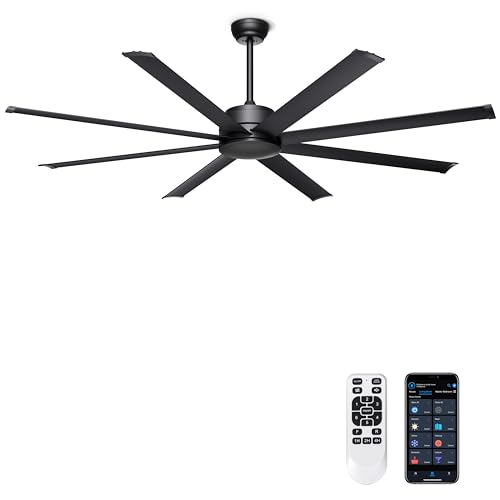
Ohniyou 72 Inch Black Industrial Ceiling Fan for Shops and Garages
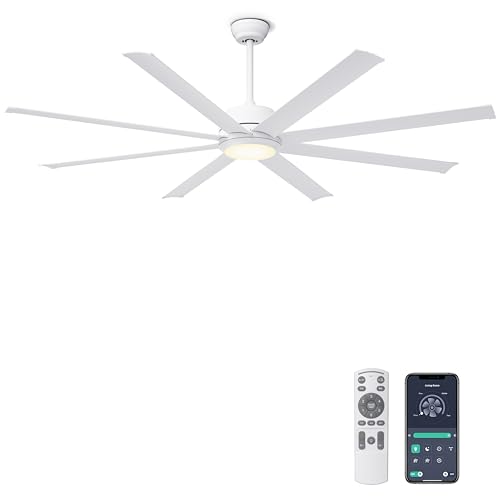
Ohniyou 72 Inch White Industrial Ceiling Fan with Light

Ohniyou 84 Inch Industrial Ceiling Fan Without Light
More Details On Our Top Picks
The Parrot Uncle 100-inch fan lands in that “almost commercial” category, the one people install when a 60-inch residential model simply can’t keep up with a two-story foyer. Eight aluminum blades span a full 100 inches, and the reversible DC motor flips between summer downdraft and winter updraft without burning through the wattage an AC motor would pull. Compared to the 60-inch Parrot Uncle covered later, this one trades footprint for genuine whole-room circulation rather than just focused cooling.
It arrives with a remote and an integrated LED light kit, so you’re not running a separate fixture. Mounting hardware is included, though the downrod length you need depends on your specific ceiling height, so measure before you order. You may find the sheer blade span demands a helper during install, and very low ceilings are not its friend.
Everyday Perks
- HVLS-style airflow (high-volume, low-speed, the same principle warehouses use) keeps the breeze gentle instead of choppy.
- Reversible motor extends use into colder months by pushing warm air down from vaulted ceilings.
- Eight aluminum blades resist warping better than MDF or plywood alternatives in humid spaces.
- Integrated light and remote ship in the box, so no separate fixture purchase.
- DC motor draws less power than traditional AC motors at the same perceived airflow.
Things To Consider
- A 100-inch span will dominate smaller rooms visually and physically; a 12×12 bedroom is the wrong room for this fan.
- Most owners report installation is a two-person job because of blade length and motor weight.
Key Specs
Right Fit For
Homeowners with vaulted great rooms, open-concept lofts, or any space where a 60-inch fan has been leaving the far corners still and warm.
Consider Something Else When
You’d be happier with the Ohniyou 84 Inch Industrial Ceiling Fan Without Light if your project is a working shop or pole barn where integrated lighting is wasted overhead.
The 60-inch Parrot Uncle is the smallest unit in this roundup, and that’s not a weakness, it’s the point. For a covered patio, a pergola, or a screen porch, a 100-inch monster creates more downforce than you want when you’re eating dinner. Sixty inches moves plenty of air under a typical 9-to-10-foot patio ceiling and stays visually proportional. It runs quieter than the 100-inch sibling, partly because the smaller motor is doing less work per blade revolution.
It includes the same remote-and-light combo as the larger Parrot Uncle models, so you’re not losing features by dropping down in size. Build leans industrial rather than farmhouse, which suits outdoor use where you want the fixture to recede rather than decorate. Just remember the light source and remote receiver are not designed for direct rain exposure, so an open pergola with no overhead cover is the wrong spot.
Where It Delivers
- Sixty-inch span clears dining tables and seating areas without blowing napkins off the table.
- Light kit means one fixture handles both jobs in spaces that don’t already have ambient lighting.
- Quieter operation at lower ceilings, since the motor is sized for shorter downrod drops.
- Industrial styling holds up visually against wood beams and exposed fasteners.
Trade Offs
- Not rated for direct rain exposure, so fully open pergolas are out.
- In a large open great room, the 60-inch span will leave corners noticeably still compared to the 72-inch and 100-inch options in this list.
- Light and electronics are damp-rated at best, so coastal humidity may shorten service life.
Made For
Anyone finishing a covered patio, screened porch, or three-season room who wants real airflow without the visual weight of an 84-inch or 100-inch fixture overhead.
A Better Fit Elsewhere
The Ohniyou 72 Inch White Industrial Ceiling Fan with Light suits you better if you have a brighter interior and want a white finish that disappears into the ceiling.
Where the other Parrot Uncle models lean industrial, this 72-inch farmhouse windmill fan is built to be noticed. Nine light gray composite wood blades fan out from a matte black metal body, a combination that reads as deliberate farmhouse or modern rustic rather than utility. The 72-inch span splits the difference between the 60-inch patio model and the 100-inch HVLS unit, and for many living rooms that turns out to be the sweet spot.
The DC motor runs at a low 40 dB on lower speeds (quieter than a typical conversation), and six speed settings give more granularity than the three-speed norm. The reversible function works for year-round comfort. Composite wood blades handle humidity better than solid hardwood, though in our view they still want a covered porch or dry interior rather than a true outdoor ceiling.
Why It Works Well
- Windmill silhouette doubles as decor, so it earns its place in rooms where a plain industrial blade would feel utilitarian.
- Six speed settings offer finer control than the typical three-speed fan.
- Composite blades hold their finish longer than natural wood in rooms with seasonal humidity swings.
Small Caveats
- Composite wood blades are not the same as the aluminum blades on the 100-inch Parrot Uncle for true outdoor exposure.
- The matte black body shows dust more visibly than lighter finishes.
Best Suited To
Anyone decorating a farmhouse, modern rustic, or transitional great room who wants the fan itself to be a design element rather than a hidden appliance.
Look Elsewhere When
The Conciseer 72 Inch Modern Ceiling Fan with Light and Remote is the stronger choice if you want tunable white color temperature and prefer a black modern profile over farmhouse.
Conciseer packs a surprising amount of lighting control into the 72-inch modern body, including a 24W dimmable LED with six selectable color temperatures (warm 2700K through daylight 5000K-plus). That means one fixture covers soft evening light, focused reading light, and bright task light without swapping bulbs. Eight blades keep the airflow even, and the reversible quiet DC motor handles year-round air circulation at noise levels that won’t compete with a TV.
The intended room list is unusually broad, covering bedrooms, living rooms, libraries, cafes, and even factory or industrial settings, and the slim low-profile body helps it fit modern ceilings where a chunky motor housing would feel dated. If you want one fan to do lighting and air duty across multiple rooms in a property, this is the most flexible option in the roundup.
What It Does Well
- Six color temperatures in one fixture mean you can match existing room lighting or change the mood on a schedule.
- Slim low-profile body suits modern interiors where a tall motor housing would look heavy.
- Reversible DC motor supports both summer and winter comfort without spiking energy use.
- Eight blades spread airflow more evenly than a five-blade unit, so no obvious “dead zones” in the room.
Factors To Consider
- Multi-function remote has a learning curve; you’ll need to sit with the manual for a few minutes before programming.
- Six color temperatures is a feature you pay a small premium for over single-temperature fixtures.
Feature Snapshot
Who It Suits Best
Anyone outfitting a flexible-use space (cafe, library, modern great room) where lighting needs change throughout the day and one fixture has to do everything.
Reach For A Different Pick When
You should grab the Parrot Uncle 100 Inch Large Ceiling Fan with Lights and Remote instead, since a 100-inch blade span with reversible DC is hard to beat for a true two-story great room.
The black Ohniyou is the no-frills workhorse of the roundup. Eight aluminum alloy blades, a reversible energy-efficient DC motor, and zero integrated lighting, because in a working shop or garage you already have task lights where you need them. The aluminum build shrugs off the rust and fading that would chew through a steel-and-composite fan in a humid workshop or partially open barn. App and remote control both come standard, so you can adjust speed without climbing down off a step stool.
This is the pick when the fan exists to move air, period, not to be looked at. Skip it if the room doubles as a finished living space, since the matte black body and bare-blade look will feel cold in a decorated interior.
Positive Takeaways
- Aluminum alloy blades resist rust, fading, and the kind of dings that happen in a working shop.
- App and remote both included, so you can adjust speed from across the shop floor.
- DC motor cuts operating cost enough to matter on a fan you run all day in summer.
- Reversible airflow helps circulate warm air down from a high shop ceiling in winter.
Honest Caveats
- No integrated light means you still need a separate fixture for task lighting.
- Black finish and bare industrial look will feel out of place in finished living areas.
Right Fit For
Garage owners, woodworkers, and shop-floor users who want durable airflow without paying for integrated lighting they will never switch on.
Skip It When
The Ohniyou 72 Inch White Industrial Ceiling Fan with Light is a better match if you want a brighter-finish fan that doubles as the room’s main light source.
Take the workshop-grade build of the black Ohniyou and add an integrated light plus a white finish, and you get a fan that disappears into a bright, airy ceiling while moving serious air. The 8 aluminum blades produce a substantial airflow reading for rooms in the 18×18 to 25×25 foot range, which covers most great rooms and covered patios. White is also the right call for coastal or sun-bleached interiors, where a black fixture would feel heavy.
It’s rated for covered patios and porches, though not for direct rain. That covers the majority of “outdoor” ceiling fan installs since fully open pergolas are rare anyway. Reversible DC motor and remote both come standard.
Advantages To Know
- White finish recedes against light ceilings, so the room reads bigger than it would with a black fixture overhead.
- Eight aluminum blades handle humidity better than MDF or plywood alternatives in covered outdoor spaces.
- Integrated light removes the need for a second ceiling fixture in a patio or covered porch.
- Reversible DC motor saves energy year-round on a fan you likely run most days.
Points To Note
- Not rated for direct rain, so an open slatted pergola with no roof is the wrong application.
- White finish shows dust and cobwebs more visibly than the black Ohniyou sibling.
Spec Overview
Built With In Mind
Homeowners with light-painted ceilings, coastal or beachy interiors, and covered porches who want airflow plus lighting in a single fixture.
Swap It Out When
The Parrot Uncle 72 Inch Farmhouse Ceiling Fan with Lights and Remote suits you better if you’d rather have a windmill silhouette than an industrial-blade look.
The 84-inch Ohniyou is the biggest fan in the roundup, and the airflow matches. Seven aluminum blades pull substantial volumes of air through high-ceiling spaces like warehouses, commercial gyms, metal buildings, and pole barns, exactly the kind of places where a 60-inch residential fan surrenders. The silver finish stays cooler visually than black in sun-exposed metal buildings, and aluminum blades hold up to the temperature swings a workshop or barn goes through.
There is no integrated light, by design: most warehouse and shop installs already have high-bay lighting. The DC motor keeps the operating cost manageable even on a fan this size. Just measure your ceiling height and any overhead doors or beams before committing; an 84-inch span needs clearance in all directions.
Everyday Wins
- Largest blade span in the roundup, sized for warehouse and pole-barn ceilings.
- Aluminum blades shrug off the heat and humidity swings of metal buildings.
- DC motor scales up to 84 inches without the energy penalty of a large AC motor.
- Silver finish looks more proportional in a metal building than black.
Less Ideal Details
- No integrated lighting, so you will still need high-bay fixtures for actual work visibility.
- 84-inch span demands a high ceiling and clear overhead space; not suited to standard 8-foot rooms.
Feature Snapshot
Whose Shelf It Belongs On
Warehouse operators, pole-barn owners, and anyone outfitting a high-ceiling commercial or agricultural space where a 60-inch residential fan is simply not enough.
Where A Sibling Pick Shines
The Parrot Uncle 100 Inch Large Ceiling Fan with Lights and Remote is a more appropriate choice if you want a similar blade-span class for a residential great room with an integrated light.
Factors To Consider When Choosing Big Industrial Ceiling Fans
Blade Span Versus Room Size
The 60-inch Parrot Uncle and the 84-inch Ohniyou may both be called “big industrial,” but they are not interchangeable. Blade span should match room footprint and ceiling height; a small room with an oversized fan creates a choppy, noisy downdraft, while an undersized fan in a warehouse just stirs the air around without moving heat. The general rule is roughly one inch of blade span per square foot of floor area, though high ceilings skew the math upward.
Motor Type and Efficiency
DC motors use less energy than traditional AC motors and typically run quieter at the same airflow, which matters for a fan you’ll leave on for hours. A reversible motor adds year-round value, pushing warm air down from a vaulted ceiling in winter instead of standing idle. If you plan to run the fan daily, the operating cost difference between AC and DC adds up over a year.
Material and Finish
Aluminum blades outlast MDF and plywood in humid or outdoor settings, since composite blades can warp or swell with moisture exposure. Finish color is a real consideration too: black fixtures anchor a room, while white and silver recede and make small or bright spaces feel larger. Match the finish to the room’s ceiling color and the room’s mood.
Light Integration and Control
Some models in this list include an integrated LED and remote, while others are airflow-only. If the room already has solid ambient lighting, a fan without an integrated light saves cost. If the fan is replacing a ceiling fixture, integrated lighting plus tunable color temperature is a meaningful upgrade. Remote and app control both ship with most of these models, but check the spec before you assume.
Key Considerations Across These Picks
Pitfalls Shoppers Hit
The most common mistake in this category is under-sizing for the room. A 60-inch fan in a 25×25 great room will technically run, but the corners will stay still and the fan will work harder on higher speeds, which means more noise. The opposite mistake is over-sizing a small bedroom with a 100-inch span, which creates a downdraft that feels like a helicopter. Measure your room and ceiling before you commit to a span.
The second pitfall is ignoring ceiling height. Industrial fans need a minimum clearance between the blades and the floor (typically around 8 feet) to move air safely and effectively. A downrod extension solves high ceilings, but a low ceiling may need a flush-mount or low-profile design instead. Always confirm the mounting configuration matches your room before ordering.
What The Higher Tier Buys
The jump from a 60-inch residential fan to an 80-plus-inch HVLS unit is not just about bigger blades. You are paying for a heavier-duty motor, a more robust mounting system, and blades engineered for thousands of hours of continuous duty. In a workshop or warehouse where the fan runs 12 hours a day, the upgrade pays back in lower energy use and longer service life. In a living room used a few hours a day, the upgrade is more about quietness and finish quality than raw durability. Match the tier to how hard you’ll run it.
Frequently Asked Questions
How big should a ceiling fan be for a large room?
Blade span should generally match the longest dimension of the room, with a 60-inch fan covering up to about 20 feet and an 84-inch or 100-inch fan covering warehouse-scale spaces. The taller the ceiling, the more blade span you want, since you are moving air across more vertical distance.
Are industrial ceiling fans loud?
Modern DC-motor industrial fans are dramatically quieter than older AC-motor models, with many running in the 30 to 40 dB range on lower speeds. You may find the noise at full speed is comparable to a box fan on medium, not a constant background hum.
Can industrial ceiling fans be used outdoors?
Some models in this list, like the white Ohniyou 72-inch and the 60-inch Parrot Uncle, are rated for covered outdoor use such as patios and porches. Fully exposed installations need a fan specifically rated for wet locations, which is a stricter standard than damp-rated outdoor fans.
Do industrial ceiling fans help in winter?
Yes, when the motor reverses to updraft mode, it pulls cool air up and pushes the warm air that has stratified at the ceiling back down into the living space. This is a meaningful benefit in rooms with vaulted or high ceilings, where winter heat bills often spike because the thermostat measures floor-level air while heat pools above.
What is the difference between AC and DC ceiling fan motors?
DC motors use direct current and an electronic controller, while AC motors use alternating current directly from your home wiring. DC motors typically draw less energy, run quieter, and offer more speed settings, while AC motors are usually a bit cheaper upfront and have a longer track record of reliability.
