

Most people shopping for a fan eventually end up in the same place: tired of the buzzing, clicking, and whirring that makes a quiet room loud again. The picks below focus on airflow you can barely hear, with enough range to handle a stuffy office, a hot kitchen, or a roommate’s light-sleeping tendencies. Each one earns its spot for a different reason, so the right match depends on where and how you plan to use it.
A Snapshot Of The Selections

Coolhill Small Desk Fan, 100-Speed Quiet Rechargeable

Coolhill Cordless Wall Mounted Fan, 100 Speeds

DREO Smart Desk Fan, 85 ft Airflow, 12″

DREO Smart Desk Fan, 85 ft Airflow, 12″

DREO Smart Tower Fan, 40″–45″ Adjustable Height
DREO Smart Tower Fan, 40″–45″ Adjustable Height

Timiyou Bladeless Tower Fan, 22 dB DC Motor
DIGIX Portable Desk Fan, 100 Speeds, 360° Rotation
The Picks, Examined More Closely
A bedside fan that disappears into the room is the goal, and the Coolhill 100-Speed comes close. The 3000mAh rechargeable cell means no cable trailing across your nightstand, and the USB-C port keeps charging universal whether you use a laptop brick or a phone charger.
For students in tight dorms or anyone working from a small desk, the digital speed readout helps in the dark, and the lowest settings stay whisper-soft for sleeping. The trade-off shows up at the highest speeds, where airflow is strong but the motor becomes more present than on larger models.
What Pays Off
- 100 speed steps let you dial in a level below “still moving” without losing airflow entirely
- USB-C charging matches the cables you already own
- Digital display is readable from a pillow or across the room
- Cordless runtime means you can move it from desk to kitchen without unplugging
Things To Consider
- At maximum speed, the motor becomes audible in a quiet bedroom, so most owners settle in the 20-40 range for overnight use
- The compact blade diameter limits throw distance, making it less suited to circulating air across a wide room
Key Specs
Who It Suits Best
Anyone working or sleeping within arm’s reach of a fan who wants minimal noise and no cable mess.
Where Another Pick Suits Better
For a fan that needs to push air across a living room, the DREO Smart Tower Fan reaches further without raising its voice.
Counter space is the enemy in small kitchens, and the Coolhill Wall Mounted Fan aims straight at that problem. The 2-in-1 design mounts on a wall for permanent placement or sits on a counter when you need to move it around.
Bunk beds, cramped bathrooms, and camper layouts all benefit from the cordless 4000mAh battery, which frees the unit from outlet placement. The 120° tilt range is generous, letting you aim airflow upward toward a lofted mattress or downward toward a stovetop.
Where It Excels
- Wall mounting clears counters, nightstands, and desk surfaces entirely
- 120° tilt aims airflow in awkward directions most desk fans cannot reach
- 4000mAh battery outlasts the 3000mAh unit on the previous pick, depending on speed
- The 100-speed dial gives the same fine control as the standalone Coolhill model
Worth Noting
- Wall installation requires drilling or a strong adhesive mount, which renters may want to weigh before committing
- The white finish shows kitchen grease and dust over time, so a quick wipe-down every few weeks keeps it looking clean
Feature Snapshot
Made For
People furnishing tight spaces where a freestanding fan simply has no room to sit.
Look Elsewhere When
Anyone wanting app or voice control will find the DIGIX Portable Desk Fan too limited and the DREO Smart Desk Fan a better fit.
The DREO Smart Desk Fan is where quiet performance meets connected convenience. At 20dB on the lowest setting, it lands in the range of a soft whisper, and the 12-inch blade helps push air further than smaller desk units can manage.
App and voice control matter more than they sound: scheduling the fan to ramp down an hour after bedtime, or nudging it on remotely from another room, removes a small daily friction. The 90° vertical and 90° horizontal oscillation together cover a wide area, which makes this a strong option for shared workspaces where one fan serves two desks.
Positive Takeaways
- Whole-room oscillation covers more area than a fixed-direction desk fan
- Voice and app control reduce the need to walk over and press buttons
- 12-hour timer handles overnight sleep cycles without intervention
Trade Offs
- Smart features require Wi-Fi setup, which is overkill for anyone who just wants airflow
- At higher speeds, the airflow is strong but the motor becomes noticeable, so mid-range settings suit most offices
Best Suited To
Smart-home households that already use voice assistants and want their fan to fit the routine.
Not Your Match When
Tight-counter kitchens will find the Coolhill Wall Mounted Fan a better fit, since it clears surface area entirely.
This sibling of the previous DREO model shares the same DNA but earns its own spot for one reason: 85 feet of throw distance. For open-plan offices or studio apartments where a single fan has to cover serious ground, that reach is the difference between feeling a breeze and feeling nothing at all.
At roughly 9.45 inches deep and wide with a 12.2-inch height, it sits comfortably on a standard desk without dominating the surface. The 7-inch blade diameter keeps the unit visually compact while the motor does the heavy lifting in the background.
Notable Gains
- 85-foot throw handles open offices, lofts, and studio layouts where smaller fans fall short
- 9 speeds let you find the lowest setting that still moves air across the room
- Same 90°+90° oscillation as the related DREO model, so coverage is consistent across the line
Points To Keep In Mind
- Larger reach means more airflow noise at the top end, so light sleepers may want to keep it on lower speeds
- Cleaning the rear grille every few weeks prevents dust buildup, which can affect motor balance over time
Quick Facts
Perfect Match For
Home offices and shared studios where one fan needs to cover a wide area quietly.
Swap It Out When
Anyone needing portability will find the DIGIX Portable Desk Fan easier to toss in a bag and carry along.
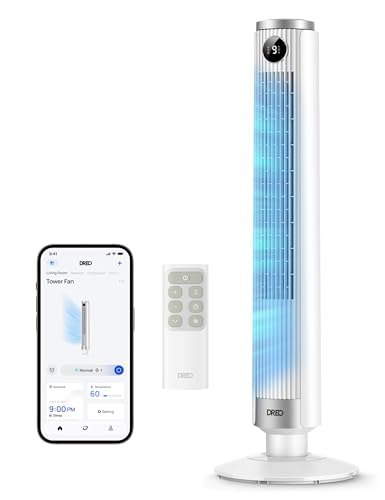
Floor fans tend to fix you in one position, and the DREO Tower Fan pushes back with a one-step pedal height adjustment from 40 to 45 inches. That range sounds small until you live with it, since the difference between seated and standing airflow is exactly the gap most fixed-height towers miss.
The 1473 CFM airflow rating suggests serious room coverage, and the 90° oscillation spreads that output across a wide arc. The DC motor is the quiet story here, running cooler and smoother than older AC motors at equivalent speeds.
Real Benefits
- Height adjustment means the fan works at a couch, a standing desk, and a bed without compromise
- DC motor runs quieter and uses less power than comparable AC motor towers
- 90° oscillation covers a wide arc, useful for living rooms where airflow needs to reach multiple seats
Room For Improvement
- Tower fans are tall and narrow, so they can tip if nudged by a pet or a child, depending on placement
- App setup adds a layer of configuration that shoppers uninterested in smart-home routines may skip
Feature Rundown
Who Will Love This
Anyone with a multi-use living space who wants one fan that adapts to where they sit, stand, or sleep.
A Better Fit Elsewhere
For a pet-safe, blade-free option, the Timiyou Bladeless Tower Fan is the sibling pick worth considering.
The second DREO Tower Fan in this roundup is functionally similar to the previous model but earns a separate entry because of how it lands for light sleepers. The 28 ft/s velocity rating gives it strong airflow without forcing the motor into a noisy top gear.
Four operating modes and 9 speeds mean a granular fit for different times of day, and the 12-hour timer is long enough to handle a full sleep cycle. The DC motor keeps things cool-running, which matters if the fan sits in a corner for hours on end.
Standout Benefits
- 28 ft/s velocity moves air quickly even at mid-range settings
- Four modes add versatility beyond simple speed changes
- 12-hour timer covers full overnight cycles without reset
Softer Spots
- Towers collect dust on the intake vents over time, depending on room cleanliness, so periodic vacuuming helps performance
- Footprint is small for a tower, but the height can crowd low-ceiling rooms once extended
Whose Shelf It Belongs On
Light sleepers and shared bedrooms where quiet operation matters more than raw power.
Reach For A Different Pick When
Anyone who needs a fan they can throw in a travel bag should look at the DIGIX Portable Desk Fan instead.
Bladeless fans tend to look futuristic, and the Timiyou Tower leans into that aesthetic with a white-and-silver finish that fits modern bedrooms. The exposed-blade-free design matters most in homes with curious toddlers or pets who treat fans like toys.
The 22 dB motor claim puts it firmly in whisper territory, and 8 speed levels offer enough range without overcomplicating the controls. The widened air outlet is the engineering story: more surface area for air to leave the unit means stronger cooling at lower noise.
Why It Works Well
- No exposed blades make it safer around kids and pets
- 22 dB operation is among the quietest specs on this list
- 90° oscillation spreads bladeless airflow across a room evenly
Honest Caveats
- Bladeless designs can feel less powerful than bladed equivalents at the same decibel level, so expectations matter
- The white-and-silver finish shows fingerprints, and the smooth surface needs regular wiping to stay clean
Spec Overview
Built With In Mind
Households with young children or pets where exposed blades are a real concern.
Where A Sibling Pick Shines
For longer reach across bigger rooms, the DREO Smart Tower Fan with 1473 CFM airflow covers more ground.
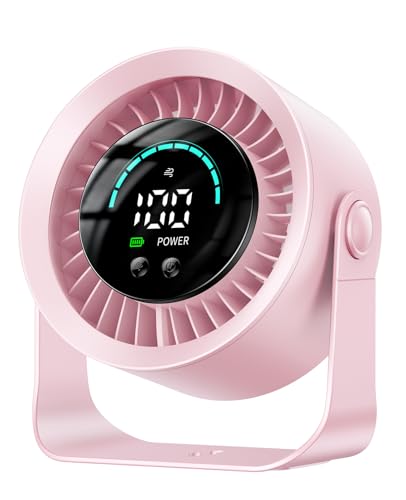
Hotels run warm, hostels run warm, and shared summer rentals are unpredictable. The DIGIX Portable Desk Fan is built to live in a bag, with USB charging that works off a laptop, a power bank, or any phone charger. The 360° rotation is the unusual part: instead of just tilting up and down, the head spins to share airflow in any direction.
For a fan this small, 100 speeds is generous, and the free adhesive hook included for wall mounting means it works in spaces without a desk to sit on. The 3-year coverage offers reassurance for anyone worried about a small fan failing on the road.
Bright Spots
- USB charging and a small footprint make it bag-friendly for travel
- 360° rotation covers a wider area than tilt-only desk fans
- Adhesive wall-mount hook adds placement flexibility in rentals
- 100 speeds let you tune the airflow down for sleeping in unfamiliar rooms
Small Caveats
- Small blade diameter means airflow is personal rather than room-filling, so it suits close-range cooling
- Battery life varies widely with speed, so heavy users may need to charge daily on long trips
The Right Fit
Travelers, campers, and anyone who needs a fan that fits in a carry-on or overnight bag.
Skip It When
For whole-room circulation at home, the DREO Smart Desk Fan moves more air with less effort.
What Matters Most Before Choosing Silent Fans
Noise Floor and Where You Sit
Decibel ratings tell part of the story, but your room shape and seating position shape the rest. A 20 dB fan on a desk sounds different from a 20 dB fan across a quiet bedroom, so think about distance. Lower dB numbers help, but the fan you sit closest to is the one whose noise you’ll judge most.
Airflow Reach Versus Blade Size
A bigger blade pushes air further, and a small desk fan is built for personal cooling, not room circulation. For open layouts, longer throw (like the 85-foot DREO model) covers more area from one placement. For bedside or desktop use, smaller blades paired with smart speed curves often feel more pleasant.
Cordless, Wall-Mount, or Floor Standing
Placement drives format more than any other choice. Wall-mounted units clear counters. Floor towers fit living rooms. Portable USB fans survive travel. Match the format to where the fan will actually live, since the quietest fan in the wrong spot won’t help.
Smart Features Versus Simplicity
App and voice control add convenience but also add setup time and a Wi-Fi dependency. The DREO models integrate into a connected home, while the Coolhill and DIGIX units keep things physical-button simple. Pick the side that matches your tolerance for configuration.
Key Considerations Across These Picks
Common Shopping Slip Ups
Buying a fan for its top speed is a familiar trap, since most owners end up using the lower half of the range. Quieter fans tend to feel more powerful at low settings than loud ones, because you keep them on without ear fatigue. A second mistake is ignoring throw distance: a fan that looks powerful on the box may not reach across a wide room. Measure where you sit, then match the fan to that distance.
Where The Extra Money Goes
Higher-tier models tend to invest in DC motors, longer throw, and smart-home integration. The DREO towers and the Timiyou bladeless unit carry that premium. For someone in a studio or shared bedroom, that upgrade pays off in quieter overnight use and better coverage. For a small dorm or office desk, the simpler Coolhill and DIGIX options handle the same cooling job at a friendlier entry point.
Frequently Asked Questions
How quiet is quiet enough for sleeping?
Most sleepers find fans below 25 dB unobtrusive, and the units in this list rated at 20 to 22 dB tend to disappear under light white noise. Personal sensitivity varies, so lower settings matter as much as the rating itself.
Do bladeless fans cool as well as bladed fans?
Bladeless designs move air differently and often feel less forceful at the same decibel level. They shine in safety-sensitive spaces and modern interiors, but for raw throw, bladed units still hold an edge.
Can a small desk fan cool a whole room?
A small desk fan cools the person sitting near it, not the whole room. For whole-room circulation, look at tower fans or larger desk units with long airflow reach.
How long do rechargeable fan batteries last?
Runtime depends on speed, with lower settings stretching battery life significantly. Many of these units last a full workday on lower settings and need recharging nightly on higher ones.
Are tower fans better than desk fans for noise?
Not necessarily: tower fans often use DC motors that run smoothly, but a well-engineered desk fan can match them. Placement and speed curve matter more than format alone.
