

Apartment water filtration works best when it fits your lease, your cabinet space, and your daily routine. Under-sink options create a dedicated drinking-water point for coffee, cooking, and refillable bottles, while reverse osmosis systems use a membrane to separate many dissolved materials from water. Your sink layout matters just as much as filtration type, especially in a compact galley kitchen where storage underneath the basin is already tight. The ten options below range from direct under-sink filters to multi-stage reverse osmosis setups with dedicated faucets.
The Essentials At A Glance

APEC Water ROES-50 Reverse Osmosis System
APEC Water ROES-PH75 Alkaline RO System
APEC Water ROES-50X RO System Extra Filters

APEC Water ROES-PHUV75 Alkaline UV RO System

APEC Water RO-90 Reverse Osmosis System

APEC Water RO-PH90 Alkaline RO System

Waterdrop 10UB Under Sink Filter with Faucet

iSpring US31-NC Under Sink Filter with Faucet

APEC Water ROES-PH75X Alkaline RO System Extra Filters

APEC Water RO-Hi Reverse Osmosis System 3/8 Output
More Details On Our Top Picks
The ROES-50 suits an apartment kitchen that needs a familiar under-sink reverse osmosis layout without stepping into higher daily output. Its five filtration stages move water through separate media and a membrane, which is the semipermeable layer that screens dissolved material before water reaches the dedicated faucet.
A 50 GPD rating means 50 gallons per day under stated conditions, a practical fit for one or two people filling bottles, pots, and a coffee maker. In a compact cabinet, you may need to reorganize cleaning supplies around the system and its storage tank.
Strengths Worth Knowing
- Five distinct stages provide a layered filtration approach.
- 50 GPD supports everyday drinking and cooking routines.
- A dedicated faucet keeps filtered water separate from dishwashing use.
- The standard under-sink format works well in established kitchen layouts.
Things To Consider
- Owners commonly need to clear meaningful cabinet room for the tank and housings.
- Filter replacement involves periodic under-sink access and shutoff steps.
Feature Snapshot
Who It Suits Best
You get the most from this system in a one- or two-person apartment with available cabinet space and steady daily drinking-water use.
Where Another Pick Suits Better
APEC Water RO-90 suits a shared apartment kitchen more comfortably when several people refill bottles and cook throughout the day.
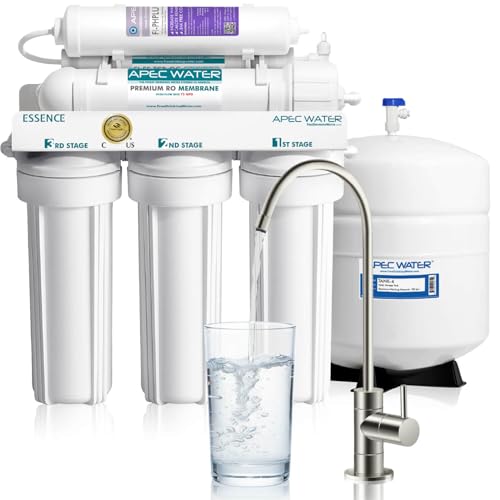
Moving up from the ROES-50 brings a sixth stage and a 75 GPD output rating. The added alkaline stage comes after reverse osmosis treatment and changes the system’s filtration sequence, which may appeal to you when that specific style of setup is part of your kitchen preference.
Seventy-five gallons per day leaves more breathing room for a couple that cooks often, makes ice, and keeps a pitcher or several bottles filled. The honest read is that your cabinet still needs to accommodate a conventional tank-based system.
Practical Advantages
- 75 GPD gives more daily capacity than the ROES-50.
- Six stages include an alkaline finishing stage.
- Extra output helps during meal prep and repeat bottle refills.
Worth Noting
- The additional stage means another component to track during routine filter changes.
- Installation still requires a cold-water connection, drain connection, and faucet opening.
- Tenants may need landlord permission before altering a countertop or sink deck.
Made For
You’ll appreciate this model in a two- to three-person home where filtered water gets used for drinks, cooking, and ice every day.
Consider Something Else When
Waterdrop 10UB Under Sink Filter with Faucet fits more neatly when you want a direct cold-water filter without a reverse osmosis tank.
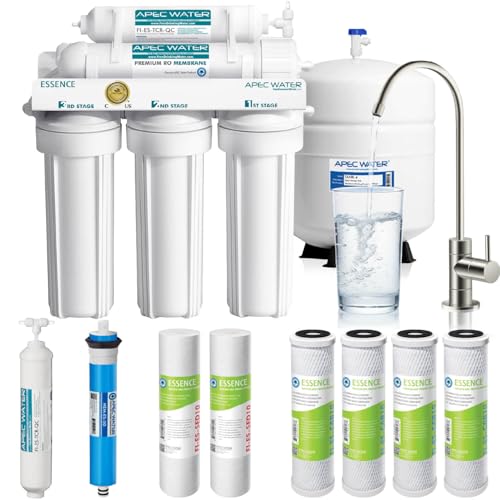
The ROES-50X follows the same 50 GPD, five-stage direction as the earlier ROES-50 but includes extra filters. That bundled supply can make sense for you when replacement planning tends to get pushed aside until the faucet flow changes.
You still receive a tank-based reverse osmosis arrangement, so this isn’t the space-saving answer for a crowded under-sink cabinet. For a renter staying put for a while, having compatible replacement media on hand may make routine upkeep less disruptive.
Positive Points
- Extra filters reduce the need to source replacements immediately.
- Five stages mirror the core structure of the ROES-50.
- 50 GPD is enough for measured daily household use.
- Keeping spare media nearby helps you maintain a regular service schedule.
- A separate faucet creates a focused spot for drinking and cooking water.
Trade Offs
- Spare filters need a dry storage spot away from sink leaks and cleaning products.
Right Fit For
You’ll get the clearest value from this option in a settled apartment household that prefers to keep replacement filters ready.
Not Your Match When
APEC Water ROES-PH75 Alkaline RO System suits you better when higher daily output matters more than storing extras.
The ROES-PHUV75 expands on the ROES-PH75 with seven stages, including alkaline and UV treatment. UV means ultraviolet light, an added light-based treatment stage that makes this a more involved setup than the straightforward five-stage models.
Its 75 GPD output suits frequent kitchen use without reaching the 90 GPD capacity of APEC Water RO-PH90 Alkaline RO System. In most apartments, the trade-off is extra under-sink complexity and another service item to remember.
The Practical Payoff
- Seven stages combine reverse osmosis, alkaline treatment, and UV treatment.
- 75 GPD supports repeat refills during active cooking days.
- The dedicated faucet separates filtered dispensing from regular tap tasks.
- DIY-oriented installation suits you when you are comfortable following plumbing instructions.
Minor Gripes
- The added UV stage creates more maintenance planning than the ROES-50.
- Cabinet space can become tight around the tank, housings, and tubing.
- Installation is less appealing for short-term rentals with strict alteration rules.
Quick Facts
Best Suited To
You’ll find this model most appropriate for a long-term apartment kitchen where extra treatment stages are worth the added cabinet commitment.
Look Elsewhere When
APEC Water ROES-50 Reverse Osmosis System is a better match for you when a simpler five-stage layout is the priority.
A 90 GPD rating is the main reason to consider the RO-90 over APEC Water ROES-50 Reverse Osmosis System. That greater daily production target suits a shared kitchen where you fill pots, make coffee, and rotate through several water bottles.
Its five-stage configuration keeps the layout less elaborate than the alkaline and UV models above. Still, higher output doesn’t make it physically smaller, and you should measure cabinet clearance before committing to a tank and multiple filter housings.
Strong Points
- 90 GPD supports households with heavier daily water use.
- Five stages keep the treatment path more straightforward than seven-stage setups.
- More output can reduce waiting around during back-to-back kitchen tasks.
Room For Improvement
- Like other reverse osmosis systems here, it takes up under-sink storage space.
- Filter housing access can be awkward in deep or narrow base cabinets.
- An alkaline finishing stage is not part of this configuration.
- Renters need a plan for restoring plumbing changes at move-out.
Who Will Love This
You’ll benefit most from the RO-90 in a busy apartment shared by roommates or family members with regular kitchen use.
A Better Fit Elsewhere
APEC Water RO-PH90 Alkaline RO System makes more sense for you when the same 90 GPD capacity plus an alkaline stage is preferred.
The RO-PH90 combines the 90 GPD capacity of the RO-90 with a sixth alkaline stage. That pairing gives you a higher-throughput system for a kitchen where water use rarely slows down after breakfast.
For apartments with multiple roommates, the added capacity can be more meaningful than a longer stage count alone. You may find the extra filtration component worthwhile, though replacement scheduling becomes a little more involved than with the five-stage RO-90.
The Value In It
- 90 GPD supports high-frequency dispensing.
- Six-stage filtration adds an alkaline finishing stage.
- Useful for cooking, ice trays, drink bottles, and coffee preparation in the same day.
- The dedicated filtered-water point keeps routine kitchen tasks organized.
- It offers more output than either 50 GPD APEC model.
Points To Note
- The extra stage creates another replacement component to maintain.
- Tank-based systems need cabinet room that some pedestal-sink apartments lack.
Who Should Grab It
This is a strong match for your high-use apartment kitchen where several people draw filtered water throughout the day.
Skip It When
iSpring US31-NC Under Sink Filter with Faucet suits you better when a tankless direct-filtration arrangement fits your cabinet more comfortably.
Waterdrop 10UB takes a different path from the APEC reverse osmosis systems because it is a direct under-sink filter with its own faucet. You avoid the bulk of a storage tank, which can matter more than extra stages in a studio apartment with one crowded base cabinet.
The system is intended for municipal tap water and cold-water lines only. That makes it a focused choice for city apartments, while well-water households need a different solution.
Everyday Advantages
- Dedicated faucet provides a separate filtered-water outlet.
- Tank-free arrangement can preserve more under-sink storage.
- Designed around municipal cold-water supplies.
- Multistage filtration gives you more than a basic single-cartridge approach.
Softer Spots
- It is not intended for hot-water connections or well water.
- Replacement filter access still needs enough room below the sink.
- A separate faucet may require a suitable sink-deck opening.
Feature Rundown
Built With In Mind
You’ll appreciate the 10UB in a city apartment where cabinet space is scarce and your water line is municipal cold water.
Another Choice May Suit
APEC Water ROES-50 Reverse Osmosis System fits you better when a reverse osmosis membrane is central to your filtration plan.
The US31-NC centers on a three-stage under-sink setup with a dedicated faucet, making it another tank-free alternative to the APEC systems. Its catalytic carbon media is designed around chloramine reduction, a useful detail for you in municipalities that use chloramine rather than chlorine in distribution systems.
Compared with Waterdrop 10UB Under Sink Filter with Faucet, this model places more attention on that particular carbon-media function. Nothing flashy here, but the one-year configuration offers a clear maintenance reference point for your household calendar.
A Few Strong Suits
- Three stages offer a defined direct-filtration setup.
- Catalytic carbon media addresses chloramine-focused needs.
- Dedicated faucet keeps filtered dispensing separate from cleanup water.
- Tank-free placement can leave room for small bins or cleaning supplies.
- One-year system coverage provides a straightforward planning interval.
Small Caveats
- Cartridge changes still require you to reach and manage the under-sink assembly.
Core Details
The Right Fit
You should consider this system for a municipal-water apartment where chloramine reduction and a tank-free design both matter.
Reach For A Different Pick When
APEC Water RO-PH90 Alkaline RO System better suits a larger household that needs substantially higher stated daily production.
APEC Water ROES-PH75X takes the ROES-PH75 format and adds extra filter capacity to the package. You get six stages, alkaline treatment, and a 75 GPD rating, so it occupies the middle ground between the simpler ROES-50X and the faster 90 GPD models.
The extra high-capacity prefilter set is the draw for an apartment household that likes to prepare for future filter changes. Your storage plan matters, though, because spare supplies and a tank-based system both compete for limited space.
Everyday Wins
- Six-stage setup includes an alkaline stage.
- 75 GPD supports regular multi-person kitchen use.
- Extra prefilters help you prepare for scheduled maintenance.
- High-capacity stage-one through stage-three filter supply reduces replacement scrambling.
Areas To Watch
- Spare filters need clean, dry storage outside the working area under your sink.
- The tank and filter assembly can limit access to garbage disposal or cleaning items.
- It may be more system than you need for occasional bottled-water refills.
Whose Shelf It Belongs On
You’ll benefit most in a long-term apartment home where your household uses filtered water often and keeps maintenance supplies organized.
Where A Sibling Pick Shines
APEC Water ROES-PHUV75 Alkaline UV RO System suits you better when a UV stage matters more than extra prefilter storage.
The RO-Hi is built around a five-stage reverse osmosis system with a 3/8-inch output connection. Compared with the RO-90, the notable distinguishing detail is that wider output line, which may suit you when faster dispensing at the dedicated faucet is a priority.
A wider line does not remove the need for cabinet planning, filter changes, or a proper drain connection. Still, for a busy kitchen, the faucet-side flow focus can be a useful practical detail rather than a headline-only feature.
What Earns Its Place
- Five treatment stages keep the system configuration focused.
- 3/8-inch output line supports a higher-flow dispensing design.
- Dedicated filtered water is convenient for filling pots and drink containers.
- Its under-sink format keeps countertop space clear.
- The system suits kitchen routines with repeated faucet use.
- It offers a different flow-oriented angle from the alkaline APEC models.
Honest Caveats
- Compatibility depends on fitting the supplied plumbing into your existing sink area.
- Owners commonly need to keep tubing organized to preserve access beneath the sink.
Key Attributes
Perfect Match For
You’ll get the most from this system in a frequently used apartment kitchen where faster faucet dispensing is more important than alkaline treatment.
Swap It Out When
APEC Water ROES-PH75 Alkaline RO System is a more suitable option for you when 75 GPD output and an alkaline stage are the preferred combination.
What Matters Before Choosing Apartment Water Filtration
Start With Your Sink Cabinet
Reverse osmosis systems need room for filter housings, tubing, a storage tank, and a dedicated faucet connection. Measure usable cabinet width, height, and depth around your drainpipe and disposal before choosing an APEC system. A direct under-sink choice such as Waterdrop 10UB Under Sink Filter with Faucet can suit your space better where a tank would consume too much storage.
Match the System to Your Water Source
Municipal water and well water do not call for the same assumptions. Waterdrop 10UB is designed for municipal cold-water use, so it is not the fit for a well-water line or a hot-water connection. Your local water report can help you identify whether chlorine, chloramine, sediment, or dissolved solids are the concern driving your choice.
Think About Daily Draw
GPD, or gallons per day, describes the stated production capacity of a reverse osmosis system. A 50 GPD system often suits a smaller household, while 75 or 90 GPD makes more sense for roommates who cook often, fill several bottles, and make ice daily. Higher output does not automatically mean a better fit, especially when your kitchen sees light use.
Plan for Installation and Upkeep
Under-sink systems require water-line and drain connections, plus periodic cartridge changes. Renters benefit from checking lease rules and asking about sink modifications before adding a dedicated faucet. Keep replacement filters dry, label your change schedule, and leave enough cabinet access to reach shutoff valves without unloading everything first.
Details That Shape Long-Term Ownership
Common Shopping Slip Ups
Choosing by stage count alone can lead you toward a larger system than your cabinet can handle. Measure around plumbing first, then match output and filtration type to your daily water use.
Where The Extra Money Goes
Higher-tier systems may add daily production capacity, alkaline treatment, UV treatment, or extra replacement filters. Those additions make sense for heavy-use kitchens or households that specifically want those features, not for every apartment sink.
Frequently Asked Questions
Do under-sink water filters work in rental apartments?
You can install many under-sink systems in an apartment with suitable plumbing and landlord permission. Your lease and sink layout should guide the final choice.
What does GPD mean on a reverse osmosis system?
GPD means gallons per day. It describes the system’s stated daily water-production capacity under its listed conditions.
Does a reverse osmosis system need a dedicated faucet?
The reverse osmosis systems in this list use a dedicated dispensing faucet. That faucet keeps filtered water separate from the main kitchen faucet.
Which option takes the least cabinet room?
Tank-free direct under-sink filters generally leave more storage room than tank-based reverse osmosis systems. Waterdrop 10UB Under Sink Filter with Faucet and iSpring US31-NC Under Sink Filter with Faucet fit that general approach.
How often do under-sink filters need attention?
Replacement timing depends on the specific cartridges and your household water use. Keeping a dated reminder helps you stay consistent with maintenance.
Closing Remarks
Your strongest apartment fit starts with the space below your sink, then moves to water source and daily demand. APEC Water ROES-50 Reverse Osmosis System suits balanced everyday use, while Waterdrop 10UB Under Sink Filter with Faucet offers a more space-conscious direct-filtration route. For a busier shared kitchen, the 90 GPD APEC options bring more stated output. Choose the system that fits your cabinet and routine without turning the kitchen into a maintenance project.
