

A ceiling fan only does so much once the bedroom turns into a sweatbox. You want moving air without a jet-engine soundtrack, and you want a unit that doesn’t dominate the room visually or force you to play thermostat police all night. The bedroom fans below run quiet, push real airflow, and keep controls simple enough that half-asleep adjustments don’t turn into fumbling exercises. Some are smart and app-driven, others are no-nonsense towers that just do the job, but all of them are sized and shaped to live in a bedroom without eating floor space.
A Side-By-Side Look

Comfort Zone 32-Inch Oscillating Tower Fan

GoveeLife 42 in. Tower Fan, 150° Oscillation

DREO Smart Fan for Bedroom, 85 ft Airflow

DREO Smart Fan for Bedroom, 85 ft Airflow (Variant)

GoveeLife 36 in. Black Tower Fan for Bedroom

GoveeLife 36 in. White Tower Fan for Bedroom
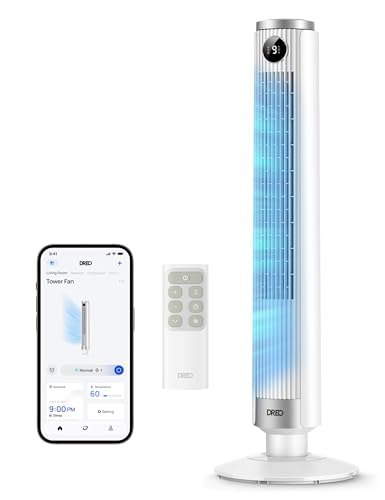
DREO Smart Tower Fan, 40″-45″ Adjustable Height

Lasko Elevation DC Tower Fan with Remote
Inside Each Recommended Option
If a tower fan ever felt intimidating, this one resets the bar. The Comfort Zone 32-Inch Oscillating Tower Fan stands 32 inches tall and uses a bladeless column to push air in a smooth, continuous stream rather than chopping it in pulses. That single design choice matters more in a bedroom than people expect, because exposed blades tend to whistle at certain angles and clip the air in a way that some sleepers find distracting.
Three speed settings cover the usual spread: a low whisper for sleeping, a medium for warmer evenings, and a high for those days when the room feels closer to a sauna. The 90° oscillation sweeps the airflow across a wide arc, so a single unit can serve a bed, a dresser, and a desk without you having to swivel it manually. A built-in carry handle on the back lets you drag it from the bedroom to the home office without a second thought, and the slim footprint slides next to a nightstand without crowding your path in the dark.
Real-World Strengths
- Bladeless design means no exposed rotor, which helps around curious pets and toddlers wandering into the room at night.
- The 90° oscillation range covers most standard bedrooms in a single sweep, so you don’t have to reposition mid-sleep.
- Low setting stays quiet enough for most sleepers; the medium step is often the sweet spot for warm nights.
- Carry handle on the rear is genuinely useful for shifting the fan between rooms in the morning.
Points To Keep In Mind
- Only three speed steps, so the jump from low to medium can feel coarse if you’re very sensitive to airflow shifts.
- No remote or app control, which means nighttime adjustments require getting up to reach the body.
- The plastic housing can show dust on the intake slots, so a quick wipe-down every week or two keeps the airflow crisp.
Who It Suits Best
First-time tower fan shoppers and anyone who wants a slim, no-fuss bedroom fan that just runs without a learning curve.
Where Another Pick Suits Better
The DREO Smart Fan (Pick 3) is the better fit if you want app and voice control from bed without getting up to tap a button.
The Comfort Zone keeps things minimal; this GoveeLife goes in the opposite direction. Standing 42 inches tall with a 150° oscillation sweep (a measurement of how far the head rotates side to side), it covers more horizontal ground than most towers, which means a single unit can cool both sides of a king bed without you angling it manually. Twelve speed steps and five mode presets give you finer control than a three-speed fan, so the difference between “comfortable” and “too much” is usually one tap away rather than one whole step.
App and voice compatibility puts the controls on your nightstand or in your voice command library, and a 24-hour timer lets the fan run a full overnight cycle without leaving it on indefinitely. Maximum wind speed reaches up to 26 ft/s at the highest setting, which is a lot of air for a tower profile. For a smart-home setup, that’s the headline number; the 27 dB bladeless claim on the low end is what matters for sleep, and it’s quiet enough for most people to fall asleep to without earplugs.
Key Advantages
- Twelve speed steps let you land on the exact airflow you want, instead of choosing between three rough presets.
- 150° oscillation is wider than typical 90° towers, useful for larger bedrooms or open layouts where you want coverage without rotation limits.
- 24-hour timer is a small but practical perk for parents who want the fan to shut off after the kid falls asleep.
- App and voice control keep the remote from getting lost between the mattress and the nightstand.
Trade-Offs
- Higher speeds produce more audible airflow noise than simpler three-speed towers, so the top settings aren’t ideal for very light sleepers.
- Smart features rely on stable Wi-Fi; you may find app pairing slower on crowded networks.
- The 42-inch height makes it less suited to low windowsills or rooms with overhead shelving.
Best Suited To
Smart-home enthusiasts who want granular speed control and the option to integrate the fan into broader routines.
Consider Something Else When
The GoveeLife 36-Inch Black Tower Fan (Pick 5) is a better fit if you prefer automatic cooling tied to a room temperature sensor rather than manual app control.
The 42-inch GoveeLife is a floor-standing tower; this DREO is a different animal. At 12 inches tall, it sits on a desk, nightstand, or dresser, and the smaller frame makes it a natural fit for dorms, home offices, or bedrooms where floor space is at a premium. Despite the small body, the 85 ft airflow reach is the kind of number you usually see on full-size towers, and the 90°+90° oscillation (sweeping both horizontally and vertically) lets the unit push air up across a person sitting in bed rather than only across their legs.
Nine speeds and 20 dB operation at the lowest end make this a strong fit for shared rooms where one person runs warm and the other is a light sleeper. App and voice compatibility sit alongside an 8- or 12-hour timer, and the compact profile makes it easy to move between the bedroom and a study nook without a second thought. The 9.45-inch footprint is small enough to live next to a laptop without crowding the desk.
The Value In It
- Compact 12-inch frame fits where full-size towers can’t, such as nightstands, dorm desks, and tight corners.
- 85 ft airflow reach is unusually long for a desk fan, useful when you want the breeze to travel across a longer room.
- 20 dB at the lowest setting is genuinely quiet, which is a meaningful upgrade for light sleepers.
- Dual-axis oscillation (90° horizontal plus 90° vertical) lets the airflow follow you when sitting up in bed.
Some Limits To Know
- At 12 inches, the fan sits low; on the floor it can feel underpowered, and you’ll want a table or shelf to get the airflow where you need it.
- App pairing takes a few extra steps compared to plug-and-play fans, which can frustrate shoppers who just want a button.
- Higher speeds, while strong, lose the whisper-quiet profile and become more noticeable in a small room.
Right Fit For
Dorm residents, remote workers, and anyone who wants full-size airflow in a desk-sized footprint.
Skip It When
The Lasko Elevation DC Tower Fan (Pick 8) is a better fit if you want a tall, room-filling floor fan rather than a desk-leaning unit.
This is the sibling version of Pick 3 with a similar 12-inch frame, similar 9.45″ x 9.45″ x 12.2″ body, and the same 85 ft airflow reach, but the product listing frames the experience around quieter bedroom use. The 20 dB floor and dual-axis oscillation are the headline features, and the 7-inch blade diameter (the measurement of the rotating blade inside the housing) gives the motor a small, fast-spinning profile that tends to hum less than larger-blade designs.
Where this variant stands apart from Pick 3 is in how it positions itself as a sleep-focused desk fan. App and voice control plus an 8/12-hour timer are present, and the unit functions essentially as a quieter, more bedroom-tuned version of the same platform. If the desktop form factor appeals but the lowest setting on the standard DREO felt too loud to you, this variant is worth a side-by-side look.
Where It Delivers
- 20 dB lowest setting is one of the quieter spec numbers in the roundup, and it matters for light sleepers.
- 12-inch body and 7-inch blade diameter keep the unit small enough to share a nightstand with a lamp and a book.
- 90°+90° dual-axis oscillation covers both the bedside and the head-of-bed reading position.
- App and voice control are useful for adjusting without getting up when the lights are already off.
Things To Consider
- The compact 12-inch profile still relies on a tabletop or shelf; floor placement leaves the airflow low and weak.
- Smart features require Wi-Fi, so in a power-outage or router-down situation you fall back on the body buttons.
- Some shoppers find the grille design a touch harder to dust than a traditional mesh tower, requiring a soft brush.
Made For
Light sleepers and bedside-table setups where whisper-quiet operation is the priority.
Not Your Match When
The GoveeLife 42 in. Tower Fan (Pick 2) is a better fit if you need floor-standing power and broader oscillation range instead of a desk profile.
The 42-inch GoveeLife gives you manual app control; this 36-inch model goes a step further with a built-in temperature sensor. That single addition changes how you actually use the fan: instead of opening an app to bump the speed, the unit can ramp up or slow down on its own as the room crosses thresholds you set. For most people, that turns the fan from a thing you fiddle with into a thing that quietly manages itself through the night.
Eight speeds, five modes, and 25 ft/s peak wind speed land slightly below the larger 42-inch sibling, but the 36-inch profile is easier to fit next to a dresser or in a smaller master bedroom. The 29 dB bladeless claim is competitive with the quieter picks in this list, and a 24-hour timer rounds out the automation story. Black finish suits darker décor or rooms where you want the fan to disappear into the background.
Everyday Advantages
- Built-in temperature sensor enables automatic speed adjustments, so you don’t have to track room warmth all night.
- App and voice control simplify integration with smart-home routines, including sleep and wake scenes.
- 24-hour timer covers full overnight and daytime use cases without manual intervention.
- 36-inch height is a practical middle ground, tall enough to push air across a bed, short enough for low ceilings.
Less Ideal Details
- Auto-cooling depends on the temperature sensor, which sits in the housing, not necessarily where you sleep, so placement affects accuracy.
- Eight speeds are fewer than the 12-step 42-inch GoveeLife, so fine-tuning is slightly less granular.
- Smart features add a small learning curve, and Wi-Fi setup may take more than a few minutes on first install.
Who Should Grab It
Shoppers who want the fan to react to the room automatically rather than relying on manual app adjustments.
Another Choice May Suit
The DREO Smart Tower Fan (Pick 7) is a better fit if you want an adjustable height range instead of a fixed 36-inch column.
Functionally identical to Pick 5, this white version exists for one clear reason: not every bedroom is dressed in dark or warm tones, and a black tower can stick out like a sore thumb in a bright, minimalist space. The white housing keeps the same temperature sensor, 8-speed motor, 25 ft/s peak, and 29 dB bladeless profile, so you give up nothing on the cooling side. You just get a finish that disappears into a Scandi-style or coastal palette.
For shared bedrooms, guest rooms, or any space where the fan stays visible rather than tucked into a corner, white plastic also tends to show dust less obviously than the black version, which is a small but real cleaning benefit. The smart-home feature set, app integration, and 24-hour timer are unchanged from the black sibling, so this is a cosmetic variant for design-minded shoppers rather than a different product.
Strengths Worth Knowing
- White finish blends into bright, minimalist, or coastal bedroom designs more cleanly than black towers.
- Same temperature sensor and auto-cooling logic as the black sibling, so functionality is identical.
- White surfaces show airborne dust less obviously than glossy black, depending on lighting.
Practical Considerations
- Functionally the same as Pick 5, so you may find the price difference too small to justify choosing one over the other.
- White plastic can yellow over time with UV exposure near bright windows.
- Smart-home features still depend on a stable Wi-Fi network to remain useful.
Perfect Match For
Design-conscious shoppers who want smart cooling without a black tower breaking up a light-colored bedroom.
Where A Sibling Pick Shines
The GoveeLife 36 in. Black Tower Fan (Pick 5) is a better fit if your bedroom leans darker or you simply prefer black electronics across the room.
Most tower fans are a fixed height, and you learn to live with whatever that height gives you. This DREO breaks that pattern with a one-step height adjustment from 40″ to 45″ via a foot pedal, so you can move from couch-sitting airflow to head-of-bed airflow without bending over. For shared bedrooms where one person reads in bed and the other works at a desk, the adjustable head makes the same fan work for both setups.
Under the hood, the DC motor (direct current, generally more efficient and quieter than older AC designs) drives 28 ft/s peak wind speed and 9 speeds across 4 modes, with a 12-hour timer for overnight runs. 90° oscillation and app/voice control match the rest of the DREO family, and 1473 CFM (cubic feet per minute, a standard airflow measurement) gives the unit serious moving-air capacity for a tower. For a multi-purpose bedroom or a room that doubles as a workspace, the height flexibility is the real differentiator.
Where It Excels
- Foot-pedal height adjustment is rare in this category and genuinely useful for shared rooms.
- DC motor tends to run quieter and more efficiently than older AC motor designs, especially at low speeds.
- 28 ft/s peak wind speed is among the higher numbers in this roundup, so the highest setting can handle a warm afternoon.
- App and voice control integrate cleanly with existing smart-home setups.
Honest Caveats
- The pedestal mechanism adds moving parts, so long-term durability of the height adjustment is a real-world consideration.
- At 45″ the fan can feel tall in a room with low ceilings or overhead shelves.
- App-controlled smart features add a small setup step relative to a basic remote-only unit.
Whose Shelf It Belongs On
Multi-use bedrooms and shared spaces where one fan has to work for both sitting and sleeping heights.
Reach For A Different Pick When
The Lasko Elevation DC Tower Fan (Pick 8) is a better fit if you need an even taller 42″-54″ reach for high-ceilinged rooms.
When the room is bigger than a standard bedroom, the Lasko Elevation earns its place. The 42″ to 54″ adjustable height range is the tallest in this roundup, and the 40 ft/s peak wind speed is a meaningful jump over the 25-28 ft/s numbers on smaller towers. For high-ceilinged primary bedrooms, lofts, or rooms with open layouts, that extra reach and velocity translate into actual cooling rather than a gentle nudge.
Eight speeds, four modes, 90° oscillation, and a child lock round out the feature set, with a quiet DC motor that holds its own against smaller units on the low end. A remote covers basic adjustments, so you don’t have to get up to dial things back at 2 a.m. The child lock is a small but practical addition for parents who worry about tiny hands changing settings.
Everyday Perks
- 42″ to 54″ height range is the tallest in the roundup, useful for high ceilings and large rooms.
- 40 ft/s peak wind speed pushes more air than any other pick listed here, which matters in open layouts.
- Child lock is a thoughtful addition for family bedrooms.
- DC motor keeps low-end operation relatively quiet despite the high-end power.
Possible Compromises
- Larger footprint and taller profile make this a less natural fit for small bedrooms with low ceilings.
- Highest speeds produce more audible airflow, which may be too much for very light sleepers.
- Remote-only control, no app, so integration with a smart-home setup is more limited than smart-equipped picks.
Built With In Mind
Larger bedrooms, lofts, and high-ceilinged primary suites where smaller towers leave air unmoved.
Swap It Out When
The GoveeLife 42 in. Tower Fan (Pick 2) is a better fit if you want app and voice integration rather than remote-only control.
What To Weigh Before Choosing Your Bedroom Fan
Tower fans and desk fans solve the same problem from different angles, and the right pick depends on how you actually sleep and use the room. Most buyers focus on three things: how loud the fan gets at the speed you’ll actually run, how much square footage a single unit can cover, and whether the controls work from your bed without you getting up.
Noise Floor vs. Airflow
Quieter fans usually mean smaller motors or carefully tuned blade designs, but quieter fans also tend to push less air. A 20 dB desk fan feels gentle but won’t move much across a large bedroom, while a 40 ft/s tower can cool the whole room but adds audible whoosh. The trade-off shows up most on warm nights, when you need both airflow and sleep. Light sleepers benefit from units with multiple low-end steps, so the lowest setting is genuinely usable, not a barely-on trickle. Power users who run warm at night benefit from the broader speed range a 12-step tower provides.
Size, Footprint, and Room Shape
A 12-inch desk fan lives on a nightstand; a 42-inch tower lives on the floor. Room shape matters too, because a narrow bedroom with the bed along the wall pairs well with a 90° oscillation tower, while a square bedroom with a centered bed benefits from a 150° unit that sweeps across both sides. For lofts and open layouts, taller units with longer airflow reach fill the space more evenly than a compact tower parked in a corner.
Smart Features and Controls
App and voice control are convenient but they add a small setup step and a dependency on stable Wi-Fi. If you already have a smart-home setup, integration is straightforward, and a temperature sensor unit can ramp up automatically as the room warms. If you want something that just runs, a remote or a body button is simpler and removes a potential failure point. Either path works, but matching the controls to your habits is the difference between a fan you love and one you ignore.
Key Considerations Across These Picks
Pitfalls Shoppers Hit
The most common mistake is choosing a fan based on peak wind speed alone, only to find the lowest setting is too weak for sleeping. Another is underestimating footprint, especially with towers that look slim in photos but take up more floor space than expected. Finally, ignoring Wi-Fi reliability can make smart features feel like a chore, so shoppers in spotty-network homes may prefer a simple remote unit.
When Paying More Pays Off
Higher-tier models in this roundup buy you things like wider oscillation, more speed steps, temperature sensors, and quieter DC motors. For a small bedroom, those upgrades are nice-to-have. For a large primary suite, a shared room, or a light sleeper, they’re often the difference between a fan you tolerate and a fan you actually rely on night after night. The honest read is that the extra cost buys refinement, not just extra power.
Frequently Asked Questions
How loud are bedroom tower fans at low speed?
Most modern bladeless towers in this roundup run between 20 dB and 30 dB on their lowest setting, which is quieter than a typical conversation and usually fine for sleep. Higher speeds produce more audible airflow, so the noise floor is generally set by the speed you’ll actually run, not the maximum.
Can a single tower fan cool a whole bedroom?
A single 36″ to 42″ tower with 90° or wider oscillation can comfortably cover most standard bedrooms. For larger primary suites or rooms with high ceilings, a taller unit with longer airflow reach is a better fit than relying on a compact tower.
Are smart fans worth it for a bedroom?
Smart features like app control, voice integration, and temperature sensors are useful if you already use a smart-home platform and want automation tied to sleep or wake routines. If you prefer simple controls, a remote-only unit removes the Wi-Fi dependency and is easier to hand off to guests.
Do tower fans or desk fans work better in small rooms?
Desk fans (like the 12-inch DREO models) work better when the airflow needs to focus on one spot, such as a bedside table or a desk. Tower fans work better when the airflow needs to sweep across the whole room, because their height and oscillation cover more horizontal area from the floor.
How do I clean a bladeless tower fan?
Bladeless towers don’t expose a rotating blade, so cleaning is mostly a matter of wiping the intake vents with a soft dry cloth every couple of weeks and using a soft brush to clear any dust from the slot. Avoid spraying cleaners directly into the housing, since moisture near the motor and electronics can cause issues.
