

Water quality concerns can show up as visible sediment, chlorine taste, or a need for cleaner water at a single kitchen tap. Your right setup depends on where you need filtration, from every shower and appliance to a countertop pitcher for an apartment kitchen. These Water Filter Systems For Home Use cover whole-house, under-sink, gravity-fed, and countertop reverse osmosis options for different routines and plumbing situations.
The Main Contenders

GE Whole House Water Filtration System GXWH40L

Purewell 2.25G Gravity Water Filter System 3-Stage PW-KS

iSpring CRO1000 4-Stage Tankless Commercial RO System 1000 GPD

GE Whole House Water Filtration System Filter Not Included GXWH20T

Express Water Whole House Filter 3-Stage
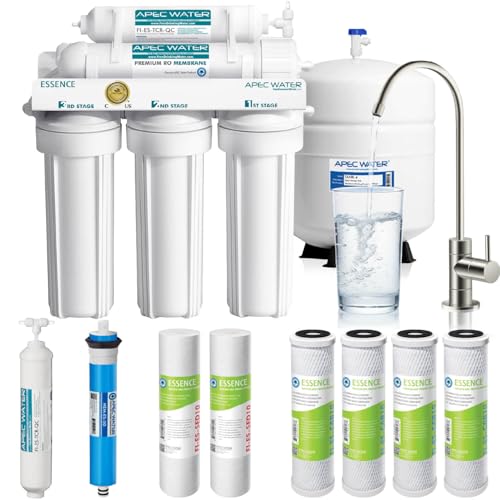
APEC Water ROES-50X 5-Stage Under Sink RO System
VonWater 7-Stage Countertop RO System CT910
More On The Choices That Made The List
Your whole home gets attention here, rather than only the kitchen sink. The GXWH40L connects to 3/4-inch plumbing and targets sand, rust, and sediment before water reaches faucets, laundry equipment, and dishwashers.
The three-position bypass valve matters during cartridge changes because your household water can keep moving through the line. For a busy home with visibly gritty water, that convenience may outweigh the larger installation commitment.
Key Advantages
- Filters sediment and rust at the incoming water line.
- Three-position bypass supports less disruptive cartridge swaps.
- Installation kit and accessories are included.
- FXHTC and FXHSC replacement filters fit this housing.
Things To Consider
- Cartridges need replacement about every three months.
- Whole-house plumbing work may suit a confident DIY setup or a plumber.
Feature Snapshot
Who It Suits Best
Your household suits this system when sediment and rust affect several fixtures and you have a 3/4-inch main line.
Where Another Pick Suits Better
Purewell 2.25G Gravity Water Filter System 3-Stage PW-KS suits your rental kitchen better when plumbing changes are off the table.
Purewell takes the opposite route from the GE GXWH40L: it sits on your counter and works without a plumbing connection. Its 2.25-gallon stainless steel reservoir has a viewing window, so you can check the fill level without lifting the lid.
Three-stage filtration includes a 0.01-micron hollow-fiber ultrafiltration membrane, meaning a fine physical barrier within the filter. You may find the gravity flow easier to live with in a small kitchen, though you need room for a tall countertop vessel.
What Earns Its Place
- No under-sink fitting or permanent installation needed.
- Level window helps you refill before your drinking supply runs low.
- Stainless steel body avoids a bulky plastic dispenser look.
- Two filters and a stand are included.
- Gravity operation suits spaces without a nearby water connection.
Worth Noting
- Refilling remains a manual part of your daily routine.
- Owners commonly need to wash the chambers carefully during filter changes.
- Counter space is required even though installation is minimal.
Quick Facts
Made For
Your apartment, dorm-style kitchen, or temporary home setup suits this gravity unit when you want filtered water without altering plumbing.
Consider Something Else When
APEC Water ROES-50X 5-Stage Under Sink RO System suits your kitchen better when you want a dedicated faucet and hidden equipment.
High-demand water stations need more output than a typical under-sink system, and the CRO1000 is built around that requirement. Reverse osmosis, often shortened to RO, uses a membrane process to separate dissolved material from water under pressure.
Its tankless layout and stated 1,000-gallon-per-day capacity suit a restaurant, small business, or large shared household more naturally than a compact apartment. Built-in inlet and outlet gauges provide a practical way to monitor line pressure.
The Practical Payoff
- 1,000 GPD capacity supports frequent draws across a busy day.
- Tankless construction avoids storing filtered water in a separate tank.
- 0.7 GPM flow rate supports a higher-demand dispensing point.
Trade Offs
- Its commercial scale requires more planning than the Purewell countertop unit.
- Water pressure below 80 psi may call for the optional PMP1000 booster pump.
- Filter service involves several stages and a more involved installation area.
- Most ordinary kitchens will not need this level of output.
Technical Sheet
Right Fit For
Your café, office refreshment point, restaurant, or high-use household suits this system when demand regularly exceeds standard kitchen output.
Not Your Match When
VonWater 7-Stage Countertop RO System CT910 suits your smaller kitchen better when portability matters more than volume.
The GXWH20T offers much of the same household sediment-management approach as the GXWH40L, including a 3/4-inch connection and three-position bypass. The key difference is that you choose and purchase the cartridge separately.
That flexibility can suit your home when you already know which GE-compatible filter type matches your water concerns. The honest read is simple: planning the initial filter selection adds a step, but it can make your setup more specific.
A Favorable Mix
- Targets sediment and rust before water reaches household fixtures.
- Bypass control makes routine service less disruptive.
- Works with FXWTC, FXUSC, FXWPC, and FXWSC filter options.
- Installation accessories are included.
Minor Gripes
- A filter is not included, so your system is not ready until you select one.
- Replacement planning remains necessary at roughly three-month intervals.
Best Suited To
Your home suits this GE housing when you want whole-house pre-filtration and prefer choosing from several compatible cartridge types.
Look Elsewhere When
Express Water Whole House Filter 3-Stage suits your household better when you want multiple filtration stages from the start.
Express Water extends filtration across your plumbing with three treatment stages rather than the single housing format of either GE option. That layered design is aimed at households that want more than visible sediment management at the point where water enters the home.
Your laundry room, showers, dishwasher, and kitchen taps all sit downstream from this kind of system. For most larger households, the main appeal is consistent coverage across several daily water uses rather than a dedicated drinking faucet.
Positive Takeaways
- Three-stage design provides a broader treatment path than a single-filter housing.
- Whole-house placement reaches water used throughout your home.
- May reduce sediment buildup reaching fixtures and appliances.
- Fits households that use several taps throughout the day.
- Targets chlorine and specified heavy metals through its staged filtration approach.
- Works well as a main-line system rather than a countertop appliance.
Room For Improvement
- Three housings create a larger installation footprint.
Who Will Love This
Your household suits this system when you want staged filtration serving bathrooms, kitchen fixtures, and utility water from one main installation.
A Better Fit Elsewhere
APEC Water ROES-50X 5-Stage Under Sink RO System suits your needs better when your focus stays on drinking and cooking water at one sink.
The ROES-50X keeps filtration focused where many homes use it most, at the kitchen tap. Its five stages and stated 50-gallon-per-day output fit cooking, coffee, refillable bottles, and everyday drinking water without taking over your countertop.
Compared with the iSpring CRO1000, this APEC setup is much more naturally sized for a standard home kitchen. You may need to clear cabinet room first, since under-sink filtration places the working components below the counter.
Strong Points
- Five treatment stages focus on filtered drinking and cooking water.
- 50 GPD capacity supports a regular household kitchen routine.
Points To Note
- Under-sink installation requires cabinet space and access to plumbing.
- RO systems send some water to drain as part of normal operation.
- Owners commonly need to track several replacement filter intervals.
Core Details
Who Should Grab It
Your kitchen suits this APEC system when you want a dedicated filtered-water faucet and have usable space below the sink.
Skip It When
Purewell 2.25G Gravity Water Filter System 3-Stage PW-KS suits your space better when drilling or plumbing work is not practical.
VonWater combines countertop placement with a seven-stage RO process and portable pitcher, making it a more self-contained alternative to the APEC under-sink system. The all-in-one filter is rated for 528 gallons, which can simplify the replacement setup.
Its stated 3:1 purified-water-to-drain ratio gives you a useful efficiency figure for a countertop RO design. Smaller kitchens may appreciate the no-plumbing format, although you still need a stable counter spot and a refill routine.
A Few Strong Suits
- Seven stages provide a detailed countertop treatment process.
- Portable pitcher lets you carry filtered water from counter to table.
- 528-gallon all-in-one filter rating reduces the number of separate cartridges.
- Five selectable volumes help match your fill to a cup, bottle, or pitcher.
Softer Spots
- Counter space remains necessary, especially in a narrow galley kitchen.
- You need to refill its source reservoir rather than draw continuously from plumbing.
Feature Rundown
Built With In Mind
Your apartment kitchen, RV-style setup, or compact counter suits this VonWater unit when you want RO filtration without under-sink work.
Another Choice May Suit
iSpring CRO1000 4-Stage Tankless Commercial RO System 1000 GPD suits your shared workplace or food-service setting better when volume is the priority.
What Matters Before Choosing Your Home Water Filter
Decide Where You Need Filtration
Whole-house units sit on the main water line, so your showers, laundry, and kitchen fixtures receive treated water. Under-sink RO systems focus on one drinking-water location, while countertop and gravity systems avoid plumbing changes. Your home’s visible sediment concerns point toward a main-line filter, while taste at the kitchen tap points toward a localized option.
Match Capacity to Your Routine
A 50 GPD under-sink RO system suits normal kitchen use, while a 1,000 GPD commercial system fits substantially heavier demand. Gravity systems need refilling, so your household’s daily bottle, coffee, and cooking habits matter. A larger reservoir can reduce refill frequency but occupies more counter space.
Plan for Filter Service
Every filtration approach needs replacement parts, cleaning, or both. Whole-house housings may need line access and shutoff planning, while countertop reservoirs need regular washing. Your maintenance routine should feel realistic before installation, not like a chore waiting in the wings.
Check the Installation Space
Measure the cabinet area for an under-sink unit and the counter height for a gravity or countertop model. Main-line systems require compatible plumbing and room around the housing for cartridge changes. Your chosen spot should leave enough working clearance for routine service.
Small Details That Shape Ownership
Common Shopping Slip Ups
Choosing a whole-house filter for a single drinking-water concern can add unnecessary installation work. Match the filter location to the fixtures where you actually need treatment, then check cartridge availability and service access.
Where The Extra Money Goes
Higher-tier systems often add treatment stages, greater output, pressure gauges, or plumbing-free convenience. Your upgrade makes sense when your household has high daily demand, limited installation options, or a specific need for whole-home coverage.
Frequently Asked Questions
Do whole-house systems filter water at every faucet?
Yes, a whole-house system installs on the incoming water line before household branches. Your showers, appliances, and sinks then receive water that has passed through the installed filter.
What does GPD mean on an RO system?
GPD means gallons per day. It states the amount of filtered water the system is designed to produce across a full day.
Do countertop water filters need plumbing?
Countertop gravity systems and reservoir-style RO units do not require a permanent plumbing connection. You fill their source reservoir manually as needed.
How often do whole-house filter cartridges need changing?
Your replacement schedule depends on the housing and cartridge type. The GE systems listed here state a three-month replacement interval for compatible filters.
Does a bypass valve matter on a whole-house filter?
A bypass valve can route water around the filter housing during service. Your household can avoid a full water interruption while you change a cartridge.
Closing Remarks
Your choice comes down to placement, capacity, and the maintenance routine you can keep up with. Choose GE or Express Water for broad household coverage, APEC or iSpring for installed RO output, and Purewell or VonWater for plumbing-free convenience. The right fit should make daily water use feel more manageable, not more complicated.
